Friday, October 14, 2011

Chapter 3b Preparation for Our Baptism of History (Goals)

Back when we hatched this idea of following the route of the 409, we decided to get ourselves out into the countryside, “La France profonde” as they say. (In France). To do that we would rent a car and travel the small roads through small towns and old cities. Some goals stood out. One, we had to see Belfort and it's monumental lion sculpture. Two, we had to see the Chateau de Joux high on a crag overlooking a pass through the Alps - originally fortified by the Romans. Three, we wanted to wander through Franche-Comté which is a region not very well-known to foreign tourists. And finally, we wanted to drive into Alsace from the south through the Ballons - the big round mountains of the southern Vosges mountain chain.


Why the Lion of Belfort? First of all he's damned impressive.


And he's got a cute face.


I had been teaching about him since 1998 when we adopted a new French 2 book at my school with a culture note about him. He was designed by Frédéric Bartholdi - of Statue of Liberty fame. (http://en.wikipedia.org/wiki/Frédéric_Auguste_Bartholdi) The Lion was dedicated to the defenders of Belfort, who successfully held out against the Prussians during the Franco-Prussian War in 1870. And as my former students know, I can't resist any reference to that favorite war of mine. There's a copy of this lion at Place Denfert-Rochereau in Paris.
*


 In addition to this famous statue here,


Bartholdi designed the statue of Lafayette at Union Square in NYC and the Bartholdi Fountain in Washington DC.


One last piece of trivia about Bartholdi - they (?) say he used his mother's face as a model for Miss Liberty. But then, they say a lot of things.


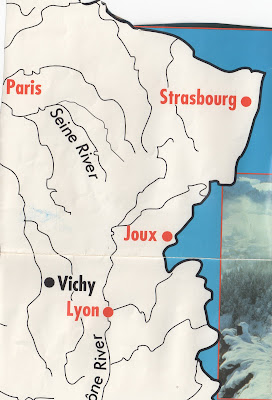
And why the Chateau de Joux? I had been inspired by a picture on an old, worn, often-folded and often-unfolded map, which I have loaded here, worn spots and all. And just to prove that I am not afraid to use a lousy image, I am going to make it really big. I hope it will impress you as much as it impresses me.


Here's the map-part to give you an idea of where Joux is.

The chateau is known for the tragic 12th century tale of Berthe de Joux, the young bride of Amaury III, who at their wedding feast announced that he was going off on the then-current crusade to the Holy Land.  She waits for him for several years until one day a wounded knight arrives at the chateau. Hopeful that it is her long-awaited husband, she finds instead a childhood friend, Amey de Montfaucon, knocking at the castle gate. Amey tells her that he had fought alongside her husband Amaury until the latter was killed in battle. In spite of her profound grief, Berthe takes care of the wounded Amey, and then, guess what - they end up in each others' arms. Until they are surprised by the no-longer-expected and not-so-dead Amaury! He of course flies into a rage, kills Amey, and locks up poor Berthe in a very tiny cell in the deepest, darkest part of the chateau. She is led out of the cell twice a day to view the rotting corpse of her lover hanging from a neaby tree. At the death of Amaury, Berthe decides to live out her life in an abbey, having rather reasonably given up on romance.
Berthe de Joux


For some fabulous photos of this chateau, plus a chilling one of poor Berthe's cell, check out this link: http://voyageusecomtoise.wordpress.com/2010/06/09/pauvre-berthe-de-joux/.  When the chateau became a prison in the 18th and 19th centuries, it housed a couple of other famous prisonners. The count of Mirabeau, orator of the French revolution was jailed there for loose morals (seducing the wrong guy's wife). Toussaint Louverture, the leader of the Haitian revolution, was imprisoned there for believing that the Revolution's motto "Liberty, equality, brotherhood" included the enslaved Africans in the French Caribbean Islands. Napolean gave him a life sentence in this cold, stone fortress in order to disabuse him of that notion.  Nappy's effort failed to discourage the Haitians however. They continued fighting and gained their independence in 1803, to become the 3rd republic in the world, and one of only two left in 1803 as the French republic had been usurped by Napoleon. The United States of American was the only other republic, but refused to recognize Haiti for another 100 years - which was one of several factors leading to that country becoming the poorest country in the Americas. Toussaint Louverture is buried on the slope below the Chateau de Joux, where only a mountain goat could possibly bring him flowers. Were I more sure-footed, I would have done so. 


As for our third goal, that of wandering through the un-touristy region of Franche-Comté, we did not know at all what we would find. But thanks to friends Kraig and Jane we were armed with a Michelin guide to the region, as well as a regional map. So discoveries would be made.


Finally, goal number four, driving through Southern Alsace and seeing the Ballons. Who wouldn't want to see a place called the "Balloons of Alsace". I imagined them in rainbow colors.


So how did reality match our goals? Tune in next time for the real story.


P.S. I am distressed by the fact that those of you with yahoo email addresses tell me that you  cannot sent us comments. PLEASE, please do comment on Facebook or to my gmail address: mcdorf@gmail.com. I enjoy hearing from you.

Wednesday, October 5, 2011

Chap. 3 Preparation for Baptism of Fire November 16 - 19, 1944

Back when the men of the 409 were training back in the States, two rumors had been prevalent. “This was a Regiment of the Division which would never go overseas. This was a Regiment of the Division which was to be a part of the Army of Occupation after the war!”  But on the evening of November 1, the Cactusmen prepared to move into combat - this was no rumor.
Over the next few days, the 409 moved north along the Rhone Valley through Valence and Dijon through heavy rains. By the morning of the 7th, they were all aware that they were entering an area of enemy air activity. Late on the dark, rainy night of Nov 9, their last night before combat, the troops reached a bivouac area in a muddy wood near the towns of Épinal and Charmois. It was a long, wakeful night for the men, who had “mixed thoughts of combat and memories of the old days back in the States.” All were wondering “What will it be like?”, “Where will I be tomorrow night? How will I act under fire? Will the experience I am about to have change my personality and outlook on life? What will it be like for me?”
Under a gray dawn sky, the men had their last hot chow and were issued live ammunition. The weather was varied as they moved into positions in the hills to the west and southwest of Saint-Dié - “it rained a little, snowed a little, and the sun shone a little.” The mountains were steep and dark in the late afternoon, and they heard artillery and small-arms fire. “They talked to some of the men of the crack 3rd Infantry Division, elements of which they  were relieving. One GI asked timorously, ‘Where is the front line from here?’  ‘Front line?’ a sergeant from the 3rd laughed, the lines of North Africa, Italy and D-Day in Southern France on his face, ‘Hell son, you’re on the front line right now.”
The first combat of the 409 involved taking three hills southwest of Saint-Dié (pronounced San Dee-ay). The Germans were holding the high ground at the tops of the hills. “German propaganda leaflets attempted to point out  the futility of American efforts to crack their mountain defenses. ‘It gets so cold here in the winter time’ the leaflets warned, ‘that the gasoline will freeze in your fuel lines. Why be miserable in the terrible winter of the Vosges Mountains?”
Charles Meagher was a soldier in the 3rd battalion, L company. These men had a long, treacherous hike up a slippery mountain trail ankle-deep in mud and through flurries of snow and showers of rain. Finally, the call came for a break. They dropped to the roadsides and were handing cigarettes around when there was an explosion, “dull and ominous.”  L company had suffered its first casualties - Pfc. Patrick H. Robinson, of Santa Fe, New Mexico, and Pfc. Jacob A. Tillema, of Kalamazoo, Michigan, were the victims of a German land mine. One can find their graves today at the American Cemetery in Dinozé, near Épinal, which we visited and left flowers on the graves of L Company soldiers buried there.


The 409’s line extended to within 5 kilometers from St. Dié, a city which has a special interest for Americans. It was here in 1507 that a geography book was printed with a map of the New world. The editors coined a name for this New World -”America”. This is the first use ever of that name. For this reason, the chamber of commerce in St. Dié considers the town to be the “world capital of geography” and “the godmother of America.” 
While the 409 waited in the hills to attack, the woods were lit with “an eerie light” from the city in flames on the other side of the German lines. In fact, the men of the 409 were occupying the same lines as in 1918. Some of the fiercest fighting of WW1 occurred near St. Dié, which was all but destroyed by fire. The city was rebuilt after that war with help from American engineers. “Now, twenty-six years later, a new American army was attempting to take and hold the city…”
Over the next 6 days, the men were occupied with routine reconnaissance and patrols to test the line and find the German positions in the hills.The short winter days and long nights “afforded the men much time to think. Rifle cleaning, issue of warm sleeping bags and inspection of positions were highlights.” It was not all monotony however. “The lessons learned in the States in the art of foxhole digging came in handy. Some of the men were lucky enough to move into foxholes which the 3d  Division had occupied. They had dug two-man foxholes and covered them with a thick layer of logs and rocks. ‘It’s a lot of work,” the 3rd Division vets had said, ‘but it’s well worth the bother when those tree bursts start coming in.”
Incoming fire from the Germans, and land mines continued to be hazards for the soldiers of the 409. But they got used to the conditions and nerves calmed considerably, except when reports came in of enemy patrol activity in the area.  After one such report, “anxious guards got a little trigger-happy, shooting at bushes that scraped trees in the darkness. Capt Marshall G. McBee, of Cheyenne, WY, coming out to inspect his guard that night was halted by one of his own guards in the darkness. The Captain couldn’t tell from where the voice was coming. “Where are you, Hernandez?” he called, a little nervously. Even more nervously, from deep down in the mud where Pvt. Pancho Hernandez had hidden came the reply, ‘Here, sir, under the jeep.”
“The days went by, one like the other, and the Regiment began expecting orders to attack Jerry. Finally, on the afternoon of the 15th, those orders came.”

Saturday, October 1, 2011

Chapter 2b WAY Over the Bounding Waves via Alitalia

On Sept. 14, Team Jeanne&Madonna moved out to Logan Airport, Boston. This maneuver had been practiced many times over the last few years on those “bargain deal” week-long jaunts to Paris in February and April visits with student groups in tow. After a 2 hour ride with our chauffeur (Jeanne’s husband Bob, who generously got us out of town) we arrived at Logan, suitcases bulging with a month’s worth of vital stuff. 
Although previously we had been spoiled by those bargain deals with Air France, sadly no such deal was in the offing last spring when the die was cast and the tickets were purchased. Lacking that, we chose Alitalia and found that the luxuries of Air France were a thing of the past. No free champagne, no little menus to ponder during take-off (instead of pondering that funny little noise in the engine), no bottomless red wine glass at dinner, no conning the steward into stealing glasses of digestif from the first-class compartment. The Italian stewards were tough characters  - totally immune to Madonna’s wheedling. Somehow I thought that Italian cuisine included good coffee, but our morning cup of joe consisted of a half inch of black coffee in the bottom of the cup - and that was it. No refills. Hardly made a dent in my caffeine withdrawal symptoms - nor did it convince cramped bodies and sandy eyes that it was indeed 7am, not 1am, and that we had “slept”.


Lest you think that all was bad with Alitalia - au contraire - there was the misting event. As we were waiting to take off, we noticed smoke near the ceiling of the plane. No one else was grabbing their emergency cards looking the steps to deal aircraft fires. In fact it was water vapor. Mist, as in the produce department at Price Chopper. So we relaxed like good little cabbages and enjoyed our spa treatment.
And then came our post-flight reward. We arrived in Paris, wound our way through baggage claim & immigration and found the airport café for our first real French coffee and croissants. Thus fortified, we were off on the RER commuter train to the 10th arrondissement of Paris. Then came the tricky part - getting out of the subway station without hauling those too-big suitcases up flight or flights of stairs. The Gare du Nord had an VERY slow creaky elevator so that was OK. Then it was off on a march to the hotel - not quite the “two-and-one-half-mile” hike but one that included circumventing café tables, crottes de chien (hint: chien means dog), and at one point an encounter with a long staircase down where our map showed a street. Ah, careful map-reading is so important.
The - Glory Be - we found, not a rocky field, but our beautiful Hotel Villa Saint-Martin. 


Situated next to the even more beautiful Canal St. Martin. 


And also, 


If you like these, there are many more at  the link above.

From there we wended our way through Burgundy, Franche Comté, and finally arrived last Sunday to Alsace where we pick up the trail of the 409.

One addition to the “WAY over the Bounding Waves” story is that we picked up Mad’s eldest brother Charlie at the Strasbourg airport last Monday. He is Charles Leo Meagher Jr. (Pronounced MAR as in MARch). 


Of course with the recent downturn in airline ticket prices, he was able to pick up an Air France ticket at a very good price. We are insanely jealous. But the good news is that he brought an giant economy size bottle of Alleve so we can recover from that long, uncomfortable flight to Paris via Rome. 


The 409 landed in Marseille after their journey across the Atlantic. We considered starting our French journey in Marseille, but decided not to do so for three reasons. One, the 409 did not stay there very long. Two, the excursion to the south of France just for the sake of historical accuracy would have been expensive in money and time. And three is that we have been there before. But to offer you readers an image of that wonderful city called the "Chicago of France", I attach the following photo of the Vieux Port, the old port.


On our visit to Marseille a few years ago with friend Jane we stayed in a hotel on the right side of the port overlooking the water and the fish market. For my favorite images EVER of Marseille, check out the following link to the movie trailer for "Fanny". When I was an overly romantic teenager with dreams of going to France one day, this movie was one that fed my dream. And I still think that Horst Bucholtz is dreamy.

http://www.youtube.com/watch?v=WI0bHn9pGYw


Lazy Madonna is going to sleep so there will be no proof-reading of this post. I apologize in advance.

Tuesday, September 27, 2011

Problems with posting comments!!

Some of you  have emailed me saying that you are unable to post comments. I have heard from those who can, and tried it myself. I think you must have a google account (gmail) or one of the others on the list at the "Select profile" down arrow, Those are:  Live Journal, word press, type pad, or AIM. I tried to insert my yahoo email account id into the last category "open id" but it would not post.  Corporate monopoly on  blogspot comment?

So if you want to comment, use your gmail account or email me at mcdorf@gmail.com. We love to hear from you!

Monday, September 26, 2011

Chapter 2 Over the Bounding Waves: October 5 to November 1, 1944


Above is a photo of the appreciation page from the 409th Infantry journal with a hand written dedication to Charles Meagher.
In relating the story of the 409th Infantry in World War II, I have chosen to use the chapter headings from the journal that was published after the war and given to all the soldiers who had served in that regiment. (See Posting #1) Therefore, Chapter 1 was called “The Cactus is Born” as written in my copy of Charles Meagher’s journal. [The family name “Meagher” by the way is pronounced “Mar” as in “MARvelous”.]  I will continue to use the chapter names from the journal as they give a flavor of the times that I feel is very authentic. In some cases the expressions are not common today. I hope that you readers will also find that they bring you a taste of the ’40’s. 

The journal itself is 167 pages long. I have read it very thoroughly and taken 20 pages of notes. (See, former students of mine? Note-taking is a useful life skill!)  While the blog account is summarized by me in my own words, I will also quote from the journal because I find the original words of those who were actually there convey the drama of the story better than I ever could. 
After each chapter, I will add a “b” version: for example after telling about the 409 going “Over the Bounding Waves”, you will find Chapter 2b “WAY over the Bounding waves” which will be the Jeanne and Madonna story of following the route of the 409.
In the beginning of October, 1944, after a year and half of training and maneuvers, the 409th Infantry reached its full strength and its orders to move out. The Allies had invaded the Normandy coast of France on D-Day, June 6 - called “Jour-J” in French. The Allies had also landed on the southern coast of France on Aug.15, and fought their way north through the Rhone Valley. Paris had also been liberated in mid-August that year, and fierce fighting was pushing the German army back into Belgium and Northeastern France. French resistance groups and French citizens were liberating towns and cities all over France. Those pockets of German resistance that remained either surrendered or tried to make their way back to their lines in the north.
On Oct. 5, 1944. The 409 was ordered to move “quickly and quietly” from Camp Shanks, New York to a railroad yard where trains were waiting. “This was not a dry run....No time was lost. No practice alerts were necessary.”  After an hour-long train ride, they were ferried across the Hudson River to the wharf. As the “Cactusmen” embarked onto the USS Monticello, a Service Command band played and Red Cross women handed out coffee and doughnuts. The following morning, the ship left port.
Although the ship had been a luxury liner, the “men also shortly learned that whatever luxuries the liner had boasted were obviously things of the past. Conditions ...were far from enjoyable.” Among the discomforts were lack of space, the “erratic operation of the ventilation system”, and “the expected siege of seasickness”.   (p. 18)
“Life above decks was as good as life below decks was bad”. Men were able to get out of the hold twice a day to enjoy the fresh air and sunshine. Entertainments included games of poker and craps, music, reading and, of course, speculation about where the Monticello and the 409 were heading. Some details of these activities taken from the journal include the following:
“The ‘jive’  addicts gathered around the stand when the Navy orchestra started playing ‘lowdown’ music. Daily music sessions were aided and abetted by appearances of the Regiment’s own master of ceremonies...and other entertainers ...(who) defied the poor acoustics in that great open air theater known as the Atlantic Ocean to sing such popular ballads as “Old Black Joe” and “Old Man River”.  (p. 20)
“The well-read aboard ship were reading The Bayous of Louisiana, The Robe, Good Night,Sweet Prince and anything by Thorne Smith.  (p. 20)
As for the speculation about their eventual destination, “after a week at sea the consensus of opinion was that the convoy was bound for the recently liberated port of Marseille.....When the convoy steamed past the Rock of Gibraltar into the Strait there was little doubt that Marseille was the port.”  (p. 21)
“About mid-day of October 20 the Monticello nosed into the dock at Marseille...Although the war had long since moved on to the northeast, Marseille was still a port of desolation and destruction. Despite 6 weeks of work by Army engineers, there were still sunken, burned-out ships in many of the docks......During disembarkation an air raid alarm was sounded and a heavy protective smoke screen covered the area. If enemy planes were over them, the Cactusmen didn’t see any bombs come down.”  (p. 21)
Now for one of those army stories that are only amusing in retrospect. The Cactusmen headed off on what was supposed to be a 2 1/2 mile march to a bivouac area, heavily burdened of course with packs, gas masks, horseshoe rolls and overcoats. “That two-and-one-half-mile report will undoubtedly live in the minds of the men of the 409th as one of the great understatements of World War II.”  After merging with other troops, slow downs, and an accident where a truck swerved into the column injuring 3 men, the column was still marching 8 hours later. Whenever anyone asked how much farther to the bivouac area, the answer came that it was “just two-and-one-half miles”.  “Eventually the men of the 409th began to think that there was a bivouac area just two-and-a-half miles from whatever point you happened to be around metropolitan Marseille.”
After 8 hours, the men bedded down where they were on a rocky field. During the night they had to use their blankets as cover during a rain storm. “Daylight revealed that the column had halted in the darkness not more than five hundred yards from its goal. A survey of the so-called ‘bivouac area’ convinced the men that it really made no difference however. It was simply a choice of rock piles.” (p.21-22)
“Life was rugged in Marseille, or so the doughboys thought. It was rather rough sleeping in a tent with only four blankets, a jacket and a raincoat to keep our the chilly October winds. How did those guys at the front manage with only one blanket? Little did the Cactusmen know that many times during the winter they would spend the night in a foxhole with no blanket whatsoever.”  (p.23)
During their stay in Marseille the soldiers of the 409th worked alongside of U.S. Navy personnel at the wharves, unloading supplies to be delivered to the front.  But their trips into the city were not all for work. “They will remember the wine, the cognac, the girls, the Red Cross club, the theaters, the sidewalk cafés, the wide streets in the heart of the city, the narrow streets of the outskirts, the churches, the blue street cars, the colorful uniforms of the soldiers of many nations.”   (p. 24)

Friday, September 23, 2011

More Paris

Beautiful architecture.....


An aqueduct in the suburb of Arcueil. Quelle surprise!

Built so that Marie de Medicis could power her fountains.

And the glass and ironwork beauty of the Auteuil Greenhouse in western Paris.

The bounty of neighborhood markets in every neighborhood, 2 - 7 days a week, all year round. Unbelievably fresh, beautiful food.


Seafood so fresh it smelled like the ocean.

North African pastries with nuts and honey.

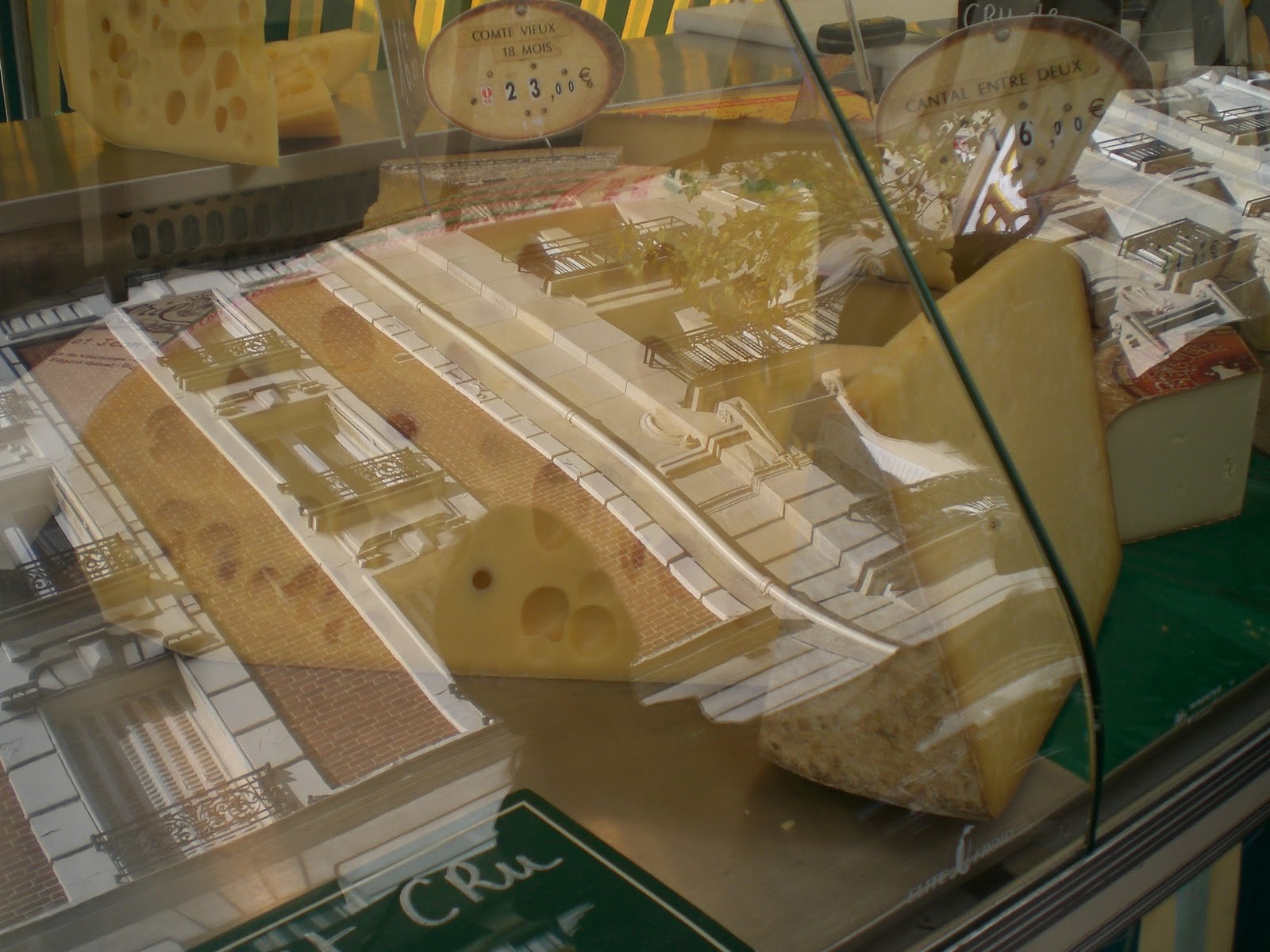
Cheeses from all regions of France.

A collection of coffee bowls.  Vendor not so pleased with my effrontery in photographing her wares.

And finally, for those sudden hunger pangs in the subway, the vending machine with Bueno Bars. This photo is for all those student travelers who only survived my death marches through Paris because of these.


À bientôt!

Tuesday, September 20, 2011

Chapter 1 The Cactus is born


Above is the dedication page to the 253 men of the 409th Infantry Regiment who died in action in the European Theater of Operations.

The first chapter of the journal tells about the formation of the regiment and the basic training that came after for the 13,000 men assigned to it when the regiment achieved full strength. They began their  basic training at Camp Claiborne, Louisiana. Subsequent training involved construction of a mock village to train for infiltration and close combat. Throughout the summer they trained on maneuvers in combination with other units.  Post maneuver training began in November of 1943 and continued until the regiment moved out of camp in October, 1944 to head to the port of New York for their voyage overseas.

If anyone is interested in the very detailed account of those maneuvers and training events, let me know and I will happily send you a copy from the journal. It is very specific and complicated and I can't tell you that I really would be competent to summarize it all.


Chapter 1b  A Road trip is born


While I'm certainly not saying that 4 days in Paris is in any way equivalent to 21 months of basic training, there are similarities. Madonna and I have pounded ourselves into shape for what's to come by logging 5 - 8 miles a day on the trusty pedometer and by climbing stairs in Métro stations, hotels, railways stations with pounds of luggage in tow. To improve our mental acuteness, we have racked our brains trying to get online in hotels (the "Wee-Fee" is not always easy to access) not to mention printing out tickets at RR stations where subtle word differences throw us off track. We've even had some munitions experiences at a local store while shopping for Opinel knives, and finding instead that they really made their money selling guns, ammo, and something that looked like grenades. Did they know we were out of place?  To cap it all off, we got to watch the bomb squad (ok - heard them) explode a suspicious package at the Barbès Métro station. (Yes, it's true Blondeel family - on the way home from dinner chez vous).  Luckily the package was not a bomb, just some forgetful person's package. Interesting to see that Parisians are as blasé as New Yorkers, looking at their watches as if to say"Hurry up and sweep up the mess. I gotta get home."

In case you think Paris was all suffering (hardly that!), we managed to enjoy ourselves thoroughly. We allowed ourselves a full day to recuperate from the rather grueling Alitalia flight - just walking around our hotel neighborhood with the beautiful Canal St. Martin, and naps. We ate North African food - the best cous-cous I've EVER had. Beautifully seasoned. Then walking back to the hotel we ran into this:

Porte St. Denis  http://en.wikipedia.org/wiki/Porte_Saint-Denis
Same in daylight

We visited the Arts et Métiers Museum (of technology & craftsmanship through the ages) http://www.arts-et-metiers.net/ where were dazzled by beautiful old instruments and tools. Note the slide rule below which is about 21/2 ft long. Must have needed quite the pocket protector! Not to mention the pocket. Ok - no one under 50 gets that.


They also had a special exhibit on the Métro system. We quickly tired of the lo-o-ong discussion of electrical systems and wen to play with the kid-friendly exhibits. We designed the following subway car-of-the-future.


And here is a model of a familiar and beloved lady:


In French she is called "Liberté éclairant le Monde" (Liberty lighting the world). She was designed by the French sculptor Frédéric Bartholdi http://fr.wikipedia.org/wiki/Frédéric_Auguste_Bartholdi and her inner structure in New York City was engineered by Gustave Eiffel. A complete statue of her is on the place outside the museum.


There are two copies of Lady Liberty in Paris as well as a life-sized copy of the flame at Pont d'Alma, near where Princess Di was killed. It was used as a memorial place when Diana was killed.

I just love all these reminders of our shared franco-american history, and mixing of our cultures and languages - in both directions.